Annex C. PCB Remediation of the Farum Midtpunkt Flats.
In September 2009, PCBs were confirmed in parts of the Farum Midtpunkt housing estate administered by the housing association KAB. Building materials containing PCBs were subsequently narrowed down to the six blocks called Birkhøjterrasserne, which comprise 295 dwellings. During the construction, caulk with a 10–30 % (w/w) content of PCB had been used. The caulk was chiefly located around internal doors, windows, and around light-weight facade elements. Some facade elements had been replaced earlier, but without paying attention to the secondary contaminations.
The PCB-contaminated building materials resulted in PCB concentrations in the indoor air of typically 1,000–2,000 ng PCB/m3 (Lundsgaard, 2013). Having realised the effects on the indoor air, the caulk was encapsulated, and several pilot studies were conducted to discover a suitable renovation method. In 2011, a ‘test block’ was selected and the renovation began. This block was finished in the spring of 2013 and Furesø Municipality approved the finished result in June 2013. Following this, renovation of the remaining blocks was set in motion. PCB concentrations in the indoor air were measured before, during, and after the abatement intervention. The results are indicated in Figure C1. During the entirety of the process, KAB had been collaborating closely with the Danish Health Authority, the Chief Medical Officer, and Furesø Municipality on the case (www.kab-bolig.dk).
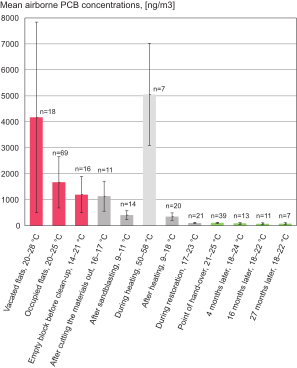
Figure C1. Airborne concentrations measured in the Birkhøjterrasserne flats before, during, and after abatement.
Claus Lundsgaard, SBMI A/S (e-mail, 22/06/2016) provided the data.
Abatement Intervention
The following is a summary of the renovation of the inner building parts of the ‘test block’ (Lundsgaard, 2013):
- Removal of internal doors, wooden floors, tiled floors, installation back walls in utility rooms, sheet cladding of back walls in living rooms (in A/D flats), kitchen units, insulation, and timber ceilings in corridor areas, old facade elements, and internal window sections in the communal areas.
- Cutting out of contaminated door-frame wood near new facade elements and upper-floor roof lights, which were retained.
- Cutting out caulk containing PCBs and the adjoining concrete at 50 mm from the joint. In load-bearing structures where cutting was impossible, the caulk was removed, the concrete surfaces were sanded clean and then sealed using a double layer of toughened silane.
- Painted walls and ceiling sheets were sandblasted to remove paint layers and grout.– The buildings were baked out using internal heating to a minimum of 50 °C for ten days with simultaneous recirculating carbon-filter air-cleaning.
No PCB-containing caulk had been applied around patio windows in living rooms (in A/D flats) and these were retained. Likewise, bathrooms were retained without major interventions.
The renovation sequence in the test block comprised the following phases (Lundsgaard, 2013):
- Light demolition and other preparatory work
- Construction of outer insulating dust-shielding walls and other shielding, as well as containment tunnels, negative pressure, and air-cleaning equipment
- Removal of caulk along with adjacent concrete and timber
- Sandblasting to remove paint and grout from walls and ceilings
- Removal of sand
- Removal or wooden and tiled floors
- Cleaning of ventilation ducts
- Cleaning
- Bake-out at 50 °C for ten days using powered fan heaters and recirculating carbon-filtrated air cleaning
- Exit clean-up
- Sealing of sanded-down surfaces
- Restoration of the building. Walls and ceilings were treated twice with spray-grouting and one coat of paint. At the end of the restoration phase, a second coat of paint was added. Heating and ventilation systems were restored as were the original systems.
During the renovation of the test block, a measurement programme had been designed for measuring PCB content in the indoor air at selected spots and at different times. The measurements served several purposes (Lundsgaard, 2013), namely:
- Documentation and assessment of the renovation
- Working environment survey in relation to airborne PCB content in reconstruction zones while bake-out is carried out in neighbouring areas
- Measurement for the purpose of assessing carbon-filter efficacy
- Reference measurements in relation to emission measurements and source-tracing
After the renovation of the test block, indoor air measurements during the restoration phase indicated concentrations of 65–138 ng PCB/m3 (February 2013). Prior to the renovation, levels were 700–1500 ng PCB/m3 in the vacated flats (Lundsgaard, 2013). After the renovation, restoration, and renewed occupancy, measurements were made repeatedly in occupied flats and communal areas, most recently in October 2015. Mean concentrations were 108–166 ng PCB/m3. Concentrations were highest during the summer heat of June 2014. Except for a singular tenant whose concentrations had the highest score every time, all the measured PCB concentrations fell below 300 ng PCB/m3. It is estimated that this tenancy was negatively affected by off-gassing from furnishings, since these had been exposed to PCBs for several years in the flats before renovation took place. In October 2014, measurements in flats and communal areas (14 in total) showed levels of 25–241 ng PCB/m3 in occupied flats and 64–314 ng PCB/m3 in communal areas.
After approx. 27 months of occupation, measurements (9 in total) in October 2015 indicated levels ranging from 27–214 ng PCB/m3. It is likely that the post-renovation measurements reflect a variation related to temperature and season (Pangel, 2014; Pangel, 2015).
Schematic Diagram of PCB Renovation
When the Birkhøjterrasserne flats were renovated to abate PCB contamination, a schematic diagram of all the building parts due for renovation was prepared. The diagram shows drawings indicating cutting profile, a photo of the specific building part and specifying whether the waste is above or below 50 mg/kg for the purpose of waste management. Building part numbers are repeated on the schematic drawings (the diagram can be found at the following url: https://www.kab-bolig.dk/om-kab/byggeri/pcb-renovering/rapporter.aspx under ’Superbilag’).
Carbon Filters
During the PCB renovation of block 46 in Birkhøjterrasserne, coarse-filter air cleaners (a HEPA H13 filter) were used along with active carbon. Carbon filters were new products developed for this kind of work and no previous experience was available as to the durability and capacity for use in PCB clean-ups. For this reason, control measurements were made on an ongoing basis to monitor PCB levels in the exhaust fumes and to measure how efficiently the filters retained PCBs. Following the clean-up of block 46, the filters were tested again. The used carbon filters still had some capacity left and in most cases were capable of effectively retaining 90–100 % of PCBs. Furthermore, the measurements showed that the seams between the individual parts of the air cleaner had to be tight and carefully made, as this was of vital importance to their efficacy. The report was prepared by Skandinavisk Biomedicinsk Institut (SBMI 17758) and can be accessed at https://www.kab-bolig.dk/om-kab/byggeri/pcb-renovering/rapporter.aspx.
After the final bake-out of the abatement intervention the air cleaners were tested. There was no sign of the carbon filters being close to saturation after having been used to clean the air for approx. 2,500 hours during the bake-out. Similarly, the carbon filters used to clean the air for up to 13,000 hours of clean-up (11,000 timer) and bake-out (2,000 hours) were not saturated. Experience from this process indicated that intermittent periods with reduced efficacy were primarily due to leakages in seams between filters and ventilators, and the ventilators (to a higher extent than the carbon filters) showed signs of use with reduced functionality and stability over time. This is described in the report, SBMI 19108, prepared by Skandinavisk Biomedicinsk Institut (see https://www.kab-bolig.dk/om-kab/byggeri/pcb-renovering/rapporter.aspx).