1. Process and Regulatory Requirements
This section is a general outline of how PCBs spread and how interventions can affect the source potency. It also provides a general description of the processes of remediation, renovation, or demolition of PCB-contaminated buildings and how remediation, renovation, and demolition are regulated.
1.1 The Spreading of PCBs
Primary sources are building materials, originally admixed with PCBs, which may still contain significant levels of PCB. Capacitors for e.g., fluorescent light ballasts can also be a primary source. Over the years, PCB may have spread from the primary source to other building materials (secondary sources) and surfaces (tertiary sources) (see SBi Guidelines 241, Survey and Assessment of Building-Related PCBs, 1.5 Primary, secondary, and tertiary sources (Andersen, 2015)).
The spreading of PCBs from original sources to other parts of a building will obstruct remediation, renovation, and demolition. If the building contains PCBs to the extent that indoor air PCB exposure levels become excessive, it may be necessary to include primary, secondary, and tertiary sources in abatement interventions (see Figure 2).
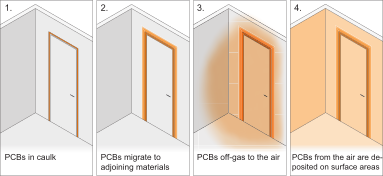
Figure 2. Migration of PCBs. Schematic illustration of PCBs in original source, here shown as caulk around a door frame (1) where PCBs have migrated to adjacent materials, both the door frame and walls (2). PCBs have also off-gassed to the indoor air (3) and from here it has been deposited on all surface areas in the room, including the walls (4).
The large tertiary contaminated surface areas present a particular challenge for remediation as their characteristics may change once the airborne PCB concentration is reduced e.g., by removing or encapsulating primary and secondary sources. Large surface areas that had previously absorbed and adsorbed PCBs from the air may begin to release PCBs into the indoor air. This may imply that removing or encapsulating primary and secondary sources will not reduce PCB levels in indoor air to acceptable levels in terms of health because PCBs in the remaining materials exposed to tertiary contamination now off-gas to the indoor air. This specific PCB characteristic also means that increased ventilation will not have a clearly defined effect (see Section 5.6.1, Mode of Action).
Although PCB levels in tertiary sources are small compared to PCB in primary sources, releases may be considerable (see SBi Guidelines 241, Survey and Assessment of Building-Related PCBs, 1.5 Primary, secondary, and tertiary sources (Andersen, 2015)).
The tertiary contamination and changed characteristics of a wall is illustrated in Figure 3.
When PCBs off-gas from a potent source to the indoor air, surface areas will absorb and adsorb PCBs from the air. If potent sources are effectively removed or reduced, their contribution to PCB levels in indoor air will drop while surface areas begin to release PCBs. Thus, a level of PCBs is maintained in the air.
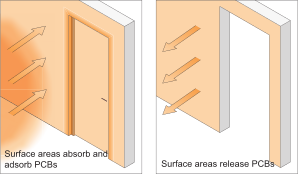
Figure 3. Schematic illustration of how a wall exposed to tertiary contamination changes from absorbing and adsorbing, to releasing PCBs after primary and secondary sources have been removed or effectively abated.
PCB dispersion from primary sources also implies that special precautions are necessary when handling materials and separating waste. Large tertiary contaminated surface areas could also present a major challenge if PCBs are to be removed from the surfaces.
1.2 Circumstances Dictate the Measures
When suspected PCB contamination of a building has been confirmed, the building owner must evaluate the available options. Circumstances will dictate which measures are feasible. If levels of PCB exposure in indoor air are excessive, there will often be one or more mitigation interventions available to the building owner, including physical removal, (see Section 2.2, Principles of Remediation and Section 5, Remediation Methods). If circumstances dictate renovation or demolition, waste containing PCB must be handled correctly and, in such cases, methods for removing PCB contamination are relevant.
Table 2 is a schematic view of circumstances dictating specific measures in PCB-contaminated buildings.
Table 2. Circumstances dictating measures in PCB-contaminated buildings.
Circumstances | Measures | Method | |
|---|---|---|---|
Source removal | Other source intervention | ||
Excessive exposure levels in indoor air | Remediation | X | X |
Repair, functional remodelling, etc. | Renovation | X | |
Removal | Demolition | X | |
Remediation, renovation, or demolition generate waste, which implies identifying, separating, and disposing of PCBs correctly (see SBi Guidelines 241, Survey and Assessment of Building-Related PCBs, 3 Surveys prior to renovation or demolition (Andersen, 2015)). Waste containing PCBs must be separated and classified, facilitating correct handling and disposal. Waste management includes the original primary sources, but also secondary and tertiary contaminated sources.
When removing materials, other environmentally harmful substances than PCB may be suspected, which need documenting. The work may therefore involve several environmentally harmful substances. Removing environmentally harmful substances during renovation or demolition is often referred to as ‘environmental clean-up’.
Table 3 details the process of remediation, renovation, and demolition. The phases shown in this example are based on the ABR89 phase model (bips, 2006).
Table 3. Process based on remediation, renovation, or demolition.
Remediation | Renovation | Demolition | |
|---|---|---|---|
Initiation | Building owner suspects PCB issues either because of the year of building or renovation work carried out during the period 1950–1977. | ||
Programme | An expert conducts preliminary study of indoor air. The building owner considers the future of the building and temporary abatement measures. An expert conducts follow-up mapping of both indoor air and materials. | The building owner completes the screening form stipulated in the Statutory Order on Waste. An expert conducts preliminary and follow-up mapping of materials. The building owner assesses need for investigations into PCBs in indoor air. | The building owner completes screening form relative to the Statutory Order on Waste. An expert conducts preliminary and follow-up mapping of materials. |
Proposals | The building owner decides in principle on remediation measures. The building owner decides in principle on methods of separating PCB from CDW. | The building owner decides in principle on methods of separating PCB from CDW. | The building owner decides in principle on methods for separating PCB from CDW. |
Project | An expert prepares detailed project on PCB management. | ||
Invitation to tender | An expert prepares tender material. The building owner selects contractor | ||
Planning the work | The contractor plans PCB handling in detail. The building owner applies for permissions and notifies the local authority about the waste. | ||
Execution | The contractors begin remediation work. The building owner checks. | The contractors start renovation, including PCB removal and handling. The building owner checks. | The contractors start PCB removal and demolition. The building owner checks. |
Completion | An evaluation of the effect of remediation on PCB levels in indoor air is performed. The building is occupied again. | The building is occupied again. | |
1.3 Regulation
Remediation, renovation, or demolition of a building containing PCBs is subject to several regulations and guidelines. This ensures a tolerable indoor climate and correct handling and disposal of materials containing PCBs. A list of relevant legislation is available at www.pcb-guiden.dk (www.pcb-guiden.dk, 2016).
1.3.1 Indoor Air
The Danish Health Authority stipulates recommended action values for PCB concentrations in indoor air of 300 ng/m3 and 3,000 ng/m3, respectively (Danish Health Authority, 2013). These action values apply to occupancy in buildings containing PCBs.
The Danish WEA stipulates recommended action values for PCB concentrations in indoor air of 1,200 ng/m3, 3,000 ng/m3, and 10,000 ng/m3, respectively (Danish WEA, 2014). These action values apply to PCB exposure
in indoor air in the workplace (e.g., an office). As these are indoor-climate values, they do not apply to renovation or demolition work where contractors work on building parts and materials containing PCBs.
See also Section 6, Protecting People and the Environment, and SBi Guidelines 241, Survey and Assessment of Building-Related PCBs (Andersen, 2015).
1.3.2 Handling Materials Containing PCBs
Handling materials and waste containing PCBs requires special health and safety precautions. Suitable personal safety equipment (PPE) must always be worn when working in areas with a risk of PCB exposure (Danish WEA, 2014).
When managing building-related PCBs, precautionary measures must be taken to limit the spread of PCBs to the surrounding environment (Danish WEA, 2014) (see Section 6, Protecting People and the Environment).
1.3.3 Construction and Demolition Waste (CDW)
CDW containing PCBs is subject to article 13 of the Statutory Order on Waste, Særlige regler om private og professionelle bygherrers identifikation af PCB i bygninger og anlæg og anmeldelse af affald (Special Rules for Private and Professional Building Owners’ Identification of PCBs in Buildings and Structures and the Notification of Waste) (Ministry of the Environment, 2012). However, hazardous waste is addressed in Section 11 of the Statutory Order on Waste (see Section 7.4.1 Hazardous Waste).
Table 4 describes different waste categories in relation to PCB concentrations in waste.
Table 4. Waste category and PCB concentrations (PCB-guiden, 2016).
Waste category | PCB (total) |
Hazardous waste | ≥ 50 mg/kg |
Non-hazardous waste | < 50 mg/kg |
Non-hazardous waste considered uncontaminated | Determined by the local authority |
See Section 7, Waste Management, and SBi Guidelines 241, Survey and Assessment of Building-Related PCBs (Andersen, 2015).