Annex B. Results from Extraction
On a tertiary contaminated surface area of painted concrete containing approx. 300 mg PCB/kg, a 99 % reduction of PCB concentrations was achieved following two treatments with an extraction agent (Krag & Rasmussen, 2011b).
Studies comprising two and three surface treatments, respectively, of two secondary contaminated concrete door rabbets with a PCB concentration of approx. 5,000 mg/kg indicated a reduction of 96 % and 99 % respectively, of PCB concentrations at 0–10 mm from the original location of the caulk (see Figure B.1, top). Subsequent measurements indicated a 97 % emission reduction from the door rabbets in both studies. The original emission rate was close to 200,000 ng/m/24-hour-period (see Figure B.1, bottom) (Krag & Rasmussen, 2011a, 2011b). Results from tests conducted up to now have had positive results.
PCB concentrations in concrete
PCB concentrations [mg/kg]
![PCB emissions [ng/m door rabbet/24-hour-period]](img/1748434681298.svg "PCB concentration in concrete")
PCB emissions
[ng/m door rabbet/24-hour-period]
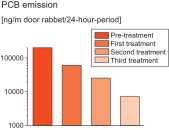
Figure B.1. Effect of NMTS (Non-Activated Metal Treatment System) treatment of door rabbet. Top: PCB concentrations in concrete by door rabbet (secondary source). Bottom: Emissions from door rabbet. Please note that this is a logarithmic scale (Krag & Rasmussen, 2011a, 2011b).
Studies have been conducted using three types of extraction agents on a concrete door rabbet removed from a flat in Birkhøjterrasserne on the Farum Midtpunkt housing estate. The door rabbet was cut out from the wall at approx. 50 mm from the joint. The caulk was removed together with the outer approx. 2 mm of the surface, both from the side facing the joint and the side facing the wall with paint and grout. Then pieces of door rabbet were treated with different types of extraction agent (see Figure 14). Three extraction agents or ‘pastes’ were tested: NMTS, clay, and active carbon. The NMTS paste is identical to the one used in the study outlined above (Kragh & Rasmussen, 2011a, 2011b). The NMTS paste applied here comprised an emulsion of ethanol, d-limonene, acetic acid, and water. Clay paste was a homogeneous mixture of clay and ethanol (330 ml ethanol/kg clay). The active carbon paste was a mixture of active carbon, propylene glycol, and ethanol (1 g active carbon:1 ml propylene glycol:1 ml ethanol). The three types of paste were applied in approx. 1 cm thick layers on the pieces of the door rabbet that faced the joint. The door rabbet and paste were then covered with vapour-impermeable plastic and sealed with aluminium tape. After two weeks, the paste was removed and subjected to chemical analysis for PCB content. Door rabbets as well as the untreated control sample were cut open and analysed for PCB content at various distances from the original joint.
In the case of the control samples, an exponential drop in PCB concentrations was evident in the concrete samples further away from the original joint. By comparison, a steeper drop in concentrations was evident in concrete samples treated with clay and active carbon while the concrete samples treated with NMTS showed a very flat process (see Figure B.2 and notice that the scale is logarithmic). Based on an analysis of the spread of the various indicator congeners, results seem to indicate that NMST treatment not only removes PCBs from the concrete, but also, to a lesser extent, increases the transport further into the material. Based on a post-study analysis of the PCB content of the extraction agent and the concrete, respectively, the two-week treatment indicates an extraction effect of 15 %, 7 %, and 10 %, respectively, for NMTS, clay, and active carbon.
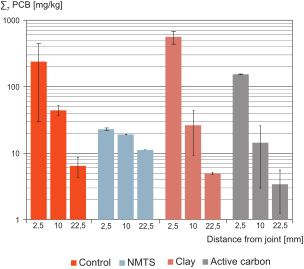
Figure B.2. Content of PCBsum7 (the seven indicator congeners) in the concrete door rabbet at various distances from the original joint. Concentrations are indicated as the mean value of two tests (allowing for standard deviations) of the control sample as well as the three types of extraction treatment.