2. Remediation
This section describes the process of mitigating excessive PCB exposure levels in indoor air from the building owner’s perspective. The planning ranges from an early stage when suspected PCB contamination in the building has been confirmed, until remediation has been implemented which will often generate waste containing PCBs. The process, as described, comprises a typical sequence of events involving certain stages, but alternative sequences exist.
Remediation includes one or more measures implemented to mitigate PCB exposure affecting building occupants. The remediation could be temporary and will then typically take place during the period between confirmation of the existence of PCB problems until a long-term solution has been found that will reduce PCB concentrations in the indoor air. A long-term solution may involve various abatement interventions such as source removal and PCB bake-out. Encapsulating the PCB may also be considered a long-term provisional solution.
The principles of remediation are described in this section whereas the remediation methods and their pros and cons are described in Section 5, Remediation Methods.
The responsibility of the building owner to inform building occupants is discussed at the end of this section.
The duties of building owners relative to safety and waste management in a building containing PCBs are described in Section 6, Protecting People and the Environment and Section 7, Waste Management.
The duties of other actors, including quality assurance, are not described in detail, but are partly subject to best management practice in the trade and partly to Bekendtgørelse om kvalitetssikring af byggearbejder (Executive Order on Quality Assurance in Construction Work) (Ministry of Industry, Business and Financial Affairs), 2010) and Vejledning om kvalitetssikring i byggeriet (Guidelines on Quality Assurance in Construction Work) (Ministry of Transport and Housing, 2001).
2.1 Key Elements of the Remediation Process
Table 5 compares the typical steps in a remediation process with the activities required when mitigating indoor air PCBs and when handling PCB-contaminated waste. The phases shown outline a process based on the ABR89 phase model (bips, 2006). Identification, investigation, and assessment of PCBs in buildings are described in SBi Guidelines 241, Survey and Assessment of Building-Related PCBs (Andersen, 2015). This is part of the initiation and programme phases (see Table 5).
Table 5. Key phases in the mitigation of indoor-air PCBs, which adversely affect human health.
Phases | PCB-specific activities | PCB-specific results | ||
|---|---|---|---|---|
Initiation |  | Building owner: - learns that the building is suspected of PCB contamination due to its year of construction or due to renovation activities carried out during the period 1950–1977. |  | Completed screening form |
- engages an expert. |  | |||
Programme |  | Expert: – conducts preliminary investigation, including a historical review, visual inspection, as well as air and, if relevant, material samples. – assesses the extent of the problem and the results of air samples. – undertakes further mapping of PCB content in building materials to identify sources of PCBs in indoor air and to facilitate the handling of waste resulting from the remediation (see Table 10). – identifies the options for temporary abatement. – draws up potential remediation strategies and financial estimates. – consider |  | Preliminary investigation report incl. mapping of materials. The report can be attached to the notification of CDW. |
 | Building owner: – considers a plan for maintenance and renovation, future function, the effect of remediation on the functioning of the building and safety issues, as well as the remediation reduction target. – assesses whether to initiate temporary abatement and, if so, prepares guidelines for occupants and service staff. | |||
Proposals |  | Building owner: – makes decision in principle on remediation strategy. |  | Decision in principle |
– if required, draws up a plan for rehousing occupants. |  | Rehousing plan | ||
 | Expert draws up remediation project proposal. |  | Project proposal | |
 | Building owner approves project proposal. |  | ||
Project |  | Expert draws up detailed project for PCB remediation, including plan for risk management. |  | Key project |
Invitation to tender |  | Expert prepares tender material with specific requirements for handling health and safety issues, waste, and the outside environment. |  | Tender material |
 | Building owner offers tender and selects contractor. |  | Contract | |
Operational planning |  | Contractor plans remediation in detail. |  | Work and time schedule |
 | Building owner applies for building permission and notifies the local authority of the waste. |  | Application for building permission and notification of CDW | |
Execution |  | Contractor commences remediation work. | ||
 | Building owner checks execution of remediation work. |  | Monitoring documentation | |
Completion |  | On behalf of the building owner, an expert makes post-remediation measurements of indoor air to assess health risks and the need to request temporary abatement measures. |  | Remeasurement report |
 | Building owner: – informs building occupants of issues concerning the use of the building, including cleaning, ventilation, airing, etc. | |||
– takes action to ensure that persons responsible for building operations are given information and documentation concerning the remaining PCBs, that are significant to future operations and maintenance. |  | Documentation for remaining PCBs | ||
– checks that persons responsible for building services include documentation of PCB issues in the operational framework, maintenance, and future repairs, and renovation. |  | Operation and maintenance manual (supplement) |
2.2 Principles of Remediation
The Danish Health Authority stipulates recommended action values for tolerable PCB concentrations in indoor air. Similarly, the Danish WEA specifies requirements about avoiding undue exposure to hazardous substances and can issue enforcement notices if excessive concentrations of PCBs are confirmed in workplace indoor air. The PCB concentration in indoor air can be abated according to two principles:
- Source abatement
- Source control
By removing or modifying sources, thereby reducing the sources of emissions PCB concentrations in indoor air can be abated. Attempts can also be made to control the source and thus the level of exposure to which building occupants are subjected, without removing PCB from the building materials. This principle is applied for preliminary temporary abatement, also in cases where e.g., encapsulating the PCB is used as a long-term solution. Combined abatement and control principles can be applied.
Table 6 shows the underlying principle of each remediation method. The methods are discussed in Section 5, Remediation Methods, and the pros and cons of each method are listed in Table 12, Section 5.11, Remediation Methods – Pros and Cons.
Table 6. View of remediation methods according to remediation principle.
Remediation | Strategy | Method |
|---|---|---|
Source abatement | Source removal | Physical removal |
Source modification | Extraction Chemical degradation PCB bake-out | |
Control of PCB exposure | Technical control | Encapsulation Ventilation Air cleaning Cleaning Lowering the temperature |
Administrative control | Limiting occupancy of the building |
2.2.1 Source Abatement
The purpose of removing or abating PCB sources is to decrease off-gassing to the indoor air. This will also remove or reduce the risk of contact exposure. Following PCB remediation there will be a need for post-intervention measurements to check the effect, but a long-term tenable solution would hopefully be the result.
For all methods of source modification, sources may still contain PCBs although PCB concentrations in the
indoor air may be at acceptable levels. Hence, later renovations or demolitions will require special considerations when handling the materials.
Table 7 shows a view of the various strategies for PCB remediation of PCB issues by source reduction.
Table 7. Schematic presentation of different remediation strategies using PCB source abatement.
Remediation | Strategy | Method | Principle |
PCB source abatement | Source removal | Physical removal | Removing building materials containing PCBs using hand tools or mechanical tools |
Source modification | Extraction | Treatment to extract PCBs from building materials | |
Chemical degradation | Treatment of building materials, converting PCBs to a less hazardous substances | ||
PCB bake-out | High-temperature treatment during which PCB off-gassing from building materials is significantly accelerated |
2.2.2 Exposure Control
The efficacy of control measures intended to curb exposure depends on the specific building and the degree of PCB contamination. Control measures are typically the first temporary abatement intervention to be implemented after identifying PCB issues (see SBi Guidelines 241, Survey and Assessment of Building-Related PCBs, 9.3 Temporary Abatement Interventions (Andersen, 2015)).
Post-intervention measurements of indoor air will disclose whether the preliminary measures were adequate. If so, a decision can be made to allow the temporary intervention to run for a longer period.
Common among the control measures is that the PCB issue remains. If PCB sources are not removed, it is particularly important to ensure that abatement interventions are implemented consistently and effectively. Guidelines for occupants and service staff must ensure that the effect of these temporary measures are maintained. Apart from this, materials containing PCB should be treated safely in connection with subsequent maintenance work, renovation, or demolition.
Except for encapsulation, these methods are not directed specifically at primary, secondary, or tertiary sources. The goal is to abate the overall effect of the sources. Nevertheless, ventilation or air cleaning may have varying effects relative to the specific source contaminating the indoor air (see Section 5.6, Ventilation and 5.7, Air Cleaning).
Any handling of PCB-contaminated materials can lead to elevated PCB concentrations in the air. Over time, PCB concentrations will usually drop again and during the intervening period, increased ventilation, and frequent cleaning, etc., will be required.Table 8 is a schematic view of control measures and the principled mode of action.
Table 8. Schematic presentation of different remediation strategies for PCBs in the indoor climate.
Remediation | Strategy | Method | Principle |
|---|---|---|---|
Control of PCB exposure | Technical control | Encapsulation | Applying film or sealant to reduce off-gassing from building materials |
Ventilation | Increased clean-air ventilation to dilute the indoor air | ||
Air cleaning | Cleaning the air using filters | ||
Cleaning | Removing dust and particles from surface areas | ||
Lowering the temperature | Avoiding an increase in temperature and thus a rise in emissions | ||
Administrative control | Limiting occupancy | Restricted period of occupancy |
2.3 Planning
Once PCB contamination has been confirmed in a building, consideration should be given to the following:
- the need for follow-up mapping(s) of the PCB contamination in the building, including several air measurements and material samples to identify the extent and type of contamination,
- remediation methods,
- waste handling,
- cost estimation,
- time schedule.
Health and safety, protection of occupants, and the outside environment must also be considered.
Removal of PCB and handling PCB-contaminated waste should be considered an integral part of the removal and management of any other environmentally harmful substances in the building. A screening should therefore be conducted by the building owner as well as follow-up mapping of other problematic substances such as lead and asbestos, if relevant. Screening may be performed using the year of building, renovation history, and choice of materials.
2.3.1 Mapping
Follow-up mapping in support of the chosen remediation method as well as correct waste management may be necessary.
Remediation
Air samples and, usually also material samples will have been collected during the preliminary mapping if excessive PCB exposure levels have been confirmed in the indoor air. This preliminary mapping should be followed up by one or more mapping processes to form a general idea of remediation needs and to identify PCB sources and secondary as well as tertiary contamination.
Identifying all PCB sources is a vital part in the remediation. If a source has been overlooked, the consequence may be that PCB concentrations are not abated to below the action values stipulated by the Danish Health Authority. The requirements stipulated by the Danish WEA may also be relevant here (see Section 6.2, Protecting Building Occupants). A source that has been overlooked could include fragments of caulk spilled or trodden underfoot below the floor finish during the building process.
Secondary and tertiary sources must also be identified. If only the primary and secondary sources are removed, tertiary sources may begin to emit PCB to the indoor air (see Section 1.1 Spreading of PCBs and SBi Guidelines 241, Survey and Assessment of Building-Related PCBs (Andersen, 2015)).
Mapping the PCB sources affecting the indoor air may also provide the basis for waste management.
If, during the visual review, fluorescent light ballasts with capacitors potentially containing PCBs are discovered, it is advisable either to remove the capacitors or ascertain that they do not contain PCBs. The Danish EPA recommends that capacitors or ballasts containing PCBs are replaced (Danish EPA, 2015) as they might leak PCBs. Likewise, the Danish EPA recommends that fluorescent light ballasts from the period 1950–1986 are not stored or reused without investigating whether the ballasts use PCB-containing capacitors. The Danish EPA has published guidelines on handling fluorescent light ballasts with capacitors containing PCBs (Danish EPA, 2015) (see SBi Guidelines 241, Survey and Assessment of Building-Related PCBs, 5.2.4 PCBs in Capacitors (Andersen, 2015)).
Waste Management
If the remediation requires the removal of materials from the building, PCBs must be identified so that the waste can be classified. Building owners have a duty to observe article 13 of the Statutory Order on Waste (Ministry of the Environment, 2012) (see Section 7, Waste Management and SBi Guidelines 241, Survey and Assessment of Building-Related PCBs, 3 Surveys prior to renovation or demolition (Andersen, 2015)).
Special considerations relative to the working environment, user protection, and the outside environment will, in part, determine the method and cost of removing PCB-containing materials. This applies to the individual interventions and to the project as a whole (e.g., waste disposal).According to the Statutory Order on Waste, PCB-containing materials removed from the building during renovation must be separated and classified (see Section 7, Waste Management).
If signed contracts are based on AB92 (Ministry of Transport and Housing, 1992), the tender material must contain information about previous investigations (e.g., concerning contamination). If the information supplied in the tender material is found to be inadequate, building owners may have to pay the contractor for the extra work involved. PCBs are considered a significant risk factor, which may have a considerable economic bearing on implementing a demolition process.
2.3.2 Remediation Strategy
Among other things the remediation process will depend on:
- PCB concentrations in indoor air,
- the quantity of PCB in building materials,
- the location of PCB-contaminated materials,
- the type, condition, and function of the building,
- the extent to which the building is operational,
- the rate of ventilation in the building.
The need for remediation can i.e. be assessed using mapping, the building’s existing ventilation systems, and air measurements before and after implementing temporary abatement interventions. The interventions implemented immediately after recognising PCB problems can be temporary for years to come if exposure concentrations are abated to tolerable levels. This will delay management of sources + in such cases, building service staff should incorporate remediation into their operational plans.
The trouble with such remediation could be that:
- it will usually not suffice to remove or encapsulate the primary sources,
- specific knowledge about the effect of secondary and tertiary sources on PCB exposure concentrations in indoor air is inadequate,
- knowledge about the long-term effects of most remediation methods is inadequate.
Finally, remediation costs must be viewed in relation to the financing of the building, its future function, and lifespan.
Experience
PCB remediation implemented in Germany indicates that remediation and renovation are building-specific and that it is impossible to follow a strictly standardised renovation concept (Bonner, 2011).
Knowledge and information from Danish cases relating to the abatement of elevated PCB concentrations in indoor air have been gathered (Haven & Langeland, 2016). Experiential information was gathered from building owners and several trade actors, including local authorities, regions, housing associations, consultants, contractors, and suppliers. Of the projects reviewed, 33 possess the underlying data and detail required to facilitate documentation of the efficacy of remediation strategies on PCB concentrations in indoor air. One of the findings revealed that the ultimate solution is highly dependent on the case and the specific building. Overall, the results show that the best chance of a satisfactory result is expected in projects where abatement is implemented in combination with several different interventions.
When determining remediation methods, consideration should be given to the following topics (Haven & Langeland, 2016):
- Removal of primary sources as part of a permanent solution. This includes capacitors in fluorescent light ballasts containing PCBs.
- Modification of air exchange and ventilation as part of a permanent solution. This could include optimising existing ventilation systems or the installation of new modern ventilation systems.
- Removal of secondary and tertiary sources or interventions believed to be crucial to PCB concentrations in indoor air. Sources not removed can be encapsulated or treated in other ways.
- PCB bake-out as a supplement to secondary or tertiary source intervention.
- Cleaning, air renewal, and lower temperatures can also be part of the permanent solution.
Recommendations
Remediation strategy and financial estimates should be based on structural conditions and the location of the PCB contamination (see SBi Guidelines 241, Survey and Assessment of Building-Related PCBs, 5 Mapping the Building Materials (Andersen, 2015)).
- The following questions should be considered with care:
- Are facade structures light- or heavy-weight?
- Are there PCB sources concealed behind panels, flashings, partition walls, or floors?
- What types of ceiling or floor finish is there and is it easy to remove?
- How are power cables and ventilation ducts placed?
- Which materials adjoin the PCB-containing caulk or other primary PCB sources – wood, clay tiles, or concrete?
- How many metres of caulk or grout require removal?
- Is it possible to cut away materials adjacent to caulked or grouted joints?
- What is the size of the surface area that requires cleaning?
- Is there any exterior caulk containing PCBs that requires removal?
- Are there any fluorescent light ballasts with capacitors that might contain PCBs?
- What are the costs of handling and disposing of the PCB-containing waste?Exterior caulk containing PCBs can contaminate indoor air if air passes over the caulk and enters via the building envelope (see Section 5.6, Ventilation).
Due to pressure differences across the facade, PCB from one-stage joints may penetrate the building structure and, from there, enter the indoor air.
In the event that the building is externally re-insulated, original exterior caulked joints will be located behind the new climate envelope and the new insulation layer. If the caulk contains PCBs, this may penetrate to the indoor air. Furthermore, materials may be contaminated with PCBs, thus complicating later renovation or demolition work.
When covering balconies in buildings with exterior grout containing PCB, consideration must be given to the possible consequences of altered airflow to avoid the penetration of PCBs to the indoor climate and the possible contamination of materials.
If PCB-containing materials are to be removed, renovation work will usually also comprise other environmentally harmful substances, typically lead. The choice of method will therefore be conditional on several issues, including:
- the depth and character of the contamination of floor finish, walls, and other surface areas,
- wall and cut-out distance when removing concrete and clay tiles from contaminated caulked joints, windows, etc.,
- the removal of tiles, paving, etc.,
- the use of personal safety equipment, period of occupancy, limited working hours, etc.,
- measures to limit the spread of PCBs to surroundings, e.g., containment tunnels, partition walls, and ventilation systems,
- the production of PCB-contaminated waste during renovation work, e.g., sand from sandblasting, water from cutting, and rubble form manual trimming,
- the collection and handling the renovation waste, and
- the ongoing control of the renovation work carried out.
When comparing methods, it is worth remembering that high-pressure blasting will only clean to a limited depth and that cleaning to greater depths requires milling or physical removal of large structural parts.
Please also remember:
- the accumulation of waste products when removing PCB in multi-storey residential buildings may result in critical structural loads
- the physical removal of large parts of the structure may be critical to static properties and the structure may need bracing prior to removal.
The Strength of Primary, Secondary, and Tertiary Sources
The concentration of PCBs in indoor air may continue to be intolerably high following careful removal of e.g. windows with caulked joints and adjacent concrete (primary and secondary sources). This may be caused by other remaining primary or secondary sources and PCBs in walls, floor finishes, and tertiary contaminated ceilings which begin to off-gas to the indoor air (see Figure 3).
Knowledge and experience as to how powerful the off-gassing from tertiary source contamination will be and how long it will last is inadequate at the present time.
It is possible to gain an impression of the strength of the various sources by measuring PCB concentrations in indoor air before and after temporary abatement interventions. Any temporary intervention will often include thorough cleaning and increasing the rate of air exchange by opening the windows or by mechanical ventilation. When measuring PCB concentrations after such temporary interventions, one might ascertain how much the concentrations have been reduced by these measures. If the primary and secondary sources have also been temporarily enclosed, one will ascertain the quantity of PCBs released into the indoor air by tertiary sources. However, it is necessary to ascertain whether the pre- and post-measurements made relative to the temporary abatement are representative and reflect the variations that may exist (see SBi Guidelines 241, Survey and Assessment of Building-Related PCBs, 1 PCBs – properties and applications (Andersen, 2015)).
If PCB concentrations cannot be abated to tolerable levels (e.g., by enclosing caulked joints plus adjacent materials and increasing ventilation), it will probably be necessary to consider tertiary sources. The remaining sources will be systematically mapped via sample collection, chemical analysis, and possibly by pilot surveys.
Pilot Surveys
German experience with complex renovation tasks connected to indoor PCB mitigating have indicated that it might be useful to conduct a pilot renovation in a room where PCB concentrations are typical for the building. Pilot renovation can verify whether the renovation target can be achieved by implementing the planned interventions (Bonner, 2011). If pilot surveys are conducted in single rooms or flats, the significance of air transfer between adjacent rooms should be considered.
During the remediation of PCB contamination in the flats on the Farum Midtpunkt housing estate, several experiments were conducted, forming the basis of a pilot renovation of a block of flats. This pilot renovation formed the basis for the choice of remediation method for the remaining blocks of flats (see Annex C. PCB Remediation of the Farum Midtpunkt Flats).Before the remediation of an adverse indoor climate at Gadstrup School near Roskilde, an experiment with heating and the release of PCBs from materials was conducted (see Annex A. Practical Experience of PCB Bake-out). This school was contaminated by leaking capacitors from fluorescent light ballasts and preliminary experiments formed the basis of the choice of remediation strategy and methods at the school.
A mobile measuring chamber was developed, which could measure the potential of the surface area of a building part to off-gas PCBs under applicable conditions. The chamber comprised a stainless-steel tray with a volume of 14.7 l which is mounted on either a wall or floor. PCB-free air is blown in through the chamber at an air velocity corresponding to a standard room with one full air exchange rate per hour. After a few days of conditioning, the PCB content in the chamber could be measured. Measurements could be made on various types of surface areas and in different locations in the room. These measurements can be used to prioritise sources and assess the need for remediation (Lyng et al., 2016).
2.3.3 Waste Containing PCBs
See Section 3.2.3, Waste Containing PCBs
2.3.4 Financial Estimates
An assessment of remediation methods includes rough estimates of:
- the costs relative to the remediation strategies outlined (including full mapping),
- the time factor associated with realising the remediation strategies outlined,
- the implications for building occupants, including an assessment of which parts of the building should be vacated and for how long.
Full mapping comprises sample collection from sources that might affect the indoor air and measurements of PCB concentrations in indoor air following the implementation of temporary abatement interventions. Laboratory or field tests capable of determining the emission potential of different sources could also be conducted.
Removing PCB-containing material and waste management may have the following financial implications:
- costs associated with waste separation (including making the working environment safe),
- concealed deposits of PCB-contaminated materials,
- the time associated with waste separation,
- special concerns in respect of neighbours and the surrounding environment.
In addition, there will be costs associated with handling and disposal of waste containing PCBs.
2.3.5 Experience-based Price Estimates
Remediation
Experience-based price estimates have been collected from several cases involving the management of building-related PCBs in Denmark. The first estimates date from the period 2010–2013 (Grontmij & COWI, 2014) while the most recent estimates date from 2015 (Haven & Langeland, 2016). Table 9 lists experience-based price estimates between 2010 and 2013.
Table 9. Estimated price levels for remediation of PCBs in the indoor climate. Prices are inclusive of VAT (Grontmij & COWI, 2014).
Building type | Size of building 1 [m2] | PCB concentration in indoor air [ng PCBtotal/m3] | Cost per building [DKK] |
|---|---|---|---|
Single- and two-family dwellings | 150 | 300–3,000 | 75,000–375,000 |
More than 3,000 | 375,000–750,000 | ||
Multi-storey residential buildings, offices, and public institutions | 5,000 | 300–3,000 | 2,500,000–12,500,000 |
More than 3,000 | 12,500,000–25,000,000 |
1 Standard house
The cases include the abatement of high PCB concentrations and the renovation, conversion, and demolition of PCB-contaminated buildings. The experience-based price estimates are based on twelve cases and include, as a minimum, all contractor costs associated with removal of building parts containing PCBs, or the implementation of the project, including the disposal of PCB-contaminated waste, health and safety measures, clean-up, etc. Furthermore, the estimates obtained also include costs of reconstructing affected building parts (e.g., fitting new windows and doors as part of the remediation), but not derived costs (e.g., for rehousing, etc).
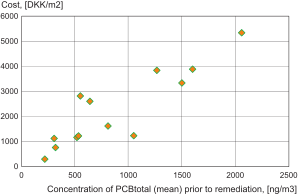
In 2015, data was again obtained from cases involving remediation (Haven & Langeland, 2016). The data indicate that the specific building is of major relevance to costs associated with PCB abatement in indoor air. However, a review of PCB remediation in twelve primary and lower secondary schools and a child-care centre showed a correlation between the remediation costs per m2 and the mean concentrations of PCB in indoor air prior to abatement (Haven & Langeland, 2016). In all cases, post-remediation PCB concentrations were all below the Danish Health Authority’s recommended action value of 300 ng/m3. The degree of detail in the cost breakdowns vary and the estimates are therefore, when compared, subject to considerable uncertainty. Generally, remediation costs rise in tandem with the need to reduce PCB concentrations in indoor air. The correlation between costs per unit area and reductions of PCB levels in indoor air are shown in Figure 4 (Haven & Langeland, 2016).Cost, [DKK/m2]
Concentration of PCBtotal (mean) prior to remediation, [ng/m3]
Figure 4. Costs (per unit area) as a function of mean PCB concentration in indoor air prior to remediation (Haven & Langeland, 2016).
Remediation costs associated with the Farum Midtpunkt housing estate totalled 9,622 DKK/m2 with mean pre-remediation PCB concentrations in the indoor air of 1200 ng/m3 (Haven & Langeland, 2016). This is the only case comprising multi-storey residential buildings and the costs are somewhat higher than for non-residential buildings. On the Farum Midtpunkt housing estate, a series of preliminary and pilot investigations were conducted in connection with the remediation planning (see Annex C. PCB Remediation of the Farum Midtpunkt Flats). The abatement interventions implemented on the Farum Midtpunkt housing estate also proved more expensive than expected based on information from 2010 to 2013 where expenses totalled 4,770 DKK/m2 (Grontmij & COWI, 2014).
Practical Work Processes
Data has been obtained from a series of practical work processes, including the removal of caulk, brickwork/concrete, windows/doors, floor finish, paint and wallpaper, and encapsulation using silicate coating (see Grontmij & COWI (2014)).
Unit prices for individual work processes vary greatly. For most work processes, there is a satisfactory correlation between unit price and quantity, but other issues are believed to have a considerable effect on unit prices. These include tender framework, type and size of the project, and quantity and occurrence of other environmentally harmful substances in the building. In addition, they include the physical conditions, access to the workplace, and the quality of the preliminary work done by the building owner, such as the preparation of preliminary investigations and tender material as well as measures concerning building occupants if the building is not vacated while the work is being carried out (Grontmij & COWI, 2014).There are examples of quotations for milling, sandblasting, or steel re-jetting for stripping paint on concrete containing PCB. Price levels and quantities of waste varied considerably (Olsen & Olesen, 2015).
2.3.6 Risk Management
During the planning stage for PCB remediation, risks should be assessed, including the risk of critical incidents, including:
- the occurrence of significant, unforeseen levels of PCB contamination,
- remediation methods that fail to function as intended,
- incidents with implications for the health and safety of staff working on the site as well as for residents in and around the building,
- critical schedule delays, and
- any kind of extraordinary cost critical to the budget.
It is advisable to prepare a list of all conceivable critical incidents with an assessment of the risk of individual incidents occurring and the subsequent consequences.
A list of critical incidents should also contain a brief plan of how such incidents and their effects could be mitigated (see Introduktion til Risikostyring i Byggeriet – erfaringer og anbefalinger (Introduction to Risk Management in the Construction Sector – Experience and Recommendations) (Falk, 2006)).
2.4 Evaluating the Draft Design
Remediation can be extensive, expensive, and time-consuming. Building owners should make a systematic assessment as to how the interventions fit in with the overall plans the owner might have for the property. Several issues should be assessed:
- The long-term plans for the building. Abatement interventions are assessed using maintenance and renovation plans envisaged for the building, including its energy performance.
- The building functions relative to present and future applications. In the case of institutions, an assessment must be made as to whether the present configuration of the building will meet requirements for future activities. If a school, this could be specialist subject rooms, group rooms, an introductory school attendance department, location of school-based care facilities (SFO), etc.
- Any long-term effects on the function of the building. Will the interventions involve rendering the building non-operational for a shorter or longer period? Time spent indoors by staff and other occupants must be considered. All abatement interventions will involve some degree of operational loss, and this should be an integral part of the decision-making process.
The remediation target must be assessed. What degree of assurance do building owners require to reduce PCB concentrations in indoor air? The various remediation measures do not necessarily provide the same degree of assurance that they will reduce PCB concentrations in buildings. This applies both to how quickly the effect manifests and how resilient the result will be to changes (in influencing factors) and their application (see Section 5, Remediation Methods).
German experience indicates that some time may elapse from the PCB abatement intervention before PCB concentrations in indoor air fall below the recommended lowest action value of 300 ng/m3. There may still be a need, therefore, for intensified air exchange and cleaning until this level has been reached (Bonner, 2011). During the work, it is very important (for reasons of health and safety) to avoid dispersing material and dust containing PCBs, to protect the environment, and to avoid recontamination of remaining materials (see Section 5.1, Physical Removal).
Increased levels of ventilation may have to be maintained for a considerable period following the interventions. Owners must decide whether increased energy consumption is acceptable and whether staff and building occupants can be expected to support a solution requiring pronounced operational changes (see Section 2.9, Communicating with Occupants and Other Involved Parties).
In addition to the question of how quickly interventions will take effect, there is also the issue of its resilience. The physical resilience of solutions (based on the encapsulation of PCB sources) depends on whether the encapsulation remains intact. The long-term effectiveness of certain solutions has not yet been documented (see Section 5, Remediation Methods). Assessments of the resilience of the intervention are relative to the function of the building, occupant behaviour, and demands for the building (which are flexible in the event of operational changes).
2.5 Choice of Remediation Method
The Guidelines cannot offer universal recommendations for any single ‘correct’ solution.
Choice of method should be based on a systematic comparison of pros and cons of practicable solutions seen from the perspective of the building owner and occupants. Possible and practical solutions are then compared to the priorities identified and the assessments made by the building owner during the draft design for remediation (see Section 2.4, Evaluating the Draft Design). Methods for removing and cleaning up PCBs as well as other methods for improving indoor air are reviewed in Section 5, Remediation Methods. Building owners must, in consultation with the local authority, determine the need and requirements relative to separating PCBs from CDW (see Section 3.2.3, Waste Containing PCBs).
Based on an overall assessment, the building owner must decide which type of remediation to implement or whether to demolish the building.
2.6 Tendering Process
Once the building owner has identified a solution which, at the draft design level, addresses abatement interventions and time schedule, a project proposal is prepared. The project proposal should specifically reflect the priorities clarified by the building owner in the preceding process. Involved parties should consider dividing the project into phases which solve acute problems whilst enabling the building owner to spread costs over several years. The project proposal should include an economic calculation for the overall project.
Based on the approved project proposal, a main project with accompanying tender material is outlined in accordance with applicable guidelines for tendering. The tender material should define and delimit the subprocesses integral to the remediation solution. The task can be implemented as several subcontracts. Therefore, methods, processes, and materials should be described separately to match prospective subcontract divisions. Steps must be taken to ensure that any such divisions will support and be compatible with the chosen renovation strategy.
Specific requirements concerning the execution should be clearly stated in the tender material. These may include:
- health and safety aspects,
- waste separation, including disposal of contaminated waste,
- safeguarding against the dispersal of PCBs to the outside environment, including emissions into the air,
- adequate screening in continued use (relative to other rooms and buildings), including reducing nuisance from noise and dust,
- access to the construction site,
- access to existing rooms and buildings in use while the work is being done,
- the collection of potentially PCB-contaminated dust derived from the removal of building materials containing PCBs (e.g., by tooling concrete, clay tiles, or timber), and
- the clean-up of exits before the building is put into operation again.
It is advisable to record the measured indoor-air PCB concentrations as a reference for comparative measurements made during the renovation process.
2.7 Project Planning and Execution
The building owner should draw up a plan for rehousing occupants. This plan could be an integral part of the communication plan and should form the basis for dialogue with occupants to reach a practical and useful solution.
Building owners have a duty to assist in complying with health and safety legislation when planning and executing PCB remediation. Accordingly, the building owner is also responsible for drawing up a Health and Safety Plan (PSS) as well as coordinating the work (see Section 6.1.1, Operators’ Duties). Pursuant to article 13 of the Statutory Order on Waste, the building owner must notify the local authority prior to commencing abatement intervention (Ministry of the Environment, 2012) (see SBi Guidelines 241, Survey and Assessment of Building-Related PCBs, 3 Surveys prior to renovation or demolition (Andersen, 2015)).
Careful layout of the workplace is necessary to optimise the working environment, to mitigate the risk of spreading PCBs to the outside environment, to make provisions for occupants in adjoining rooms or buildings, and to ensure a rational work process. This is described in Section 6, Protecting People and the Environment.
2.8 Control and Documentation
Contractors document the work performed on an ongoing basis. The building owner or his adviser should prepare a plan for assuring, controlling, and documenting the quality of the work being carried out. The building owner should ensure the efficacy of this plan by conducting an ongoing documented inspection of the work being carried out. In addition to the usual procedures for quality assurance in construction work, the types, and quantities of PCB-contaminated building materials (classified as hazardous waste, suitable for landfill, incineration, and recovery) must be calculated and reported. PCB-contaminated waste must be separated out from materials for recovery (see Section 7.4, Classifying Waste).
It is advisable that the contracting enterprise document the specific PPE and technical aids used during the processes undertaken. Filter changes should be part of the documentation for fresh-air supply systems and for large ventilation systems filtrating exhaust air to the outside environment. These and similar requirements are incorporated into the tender material (preferably with specifications of submission format, etc).
Generally, the rules of the Danish WEA and the Danish EPA must be complied with (see Section 6, Protecting People and the Environment and Section 7, Waste Management).
Project supervisors and consultants have a duty to describe special risks and other issues relevant to health and safety when dealing with building-related PCBs (see Section 6.1.1, Operators’ Duties). Project supervisors must, for example, describe structural issues and design solutions for future use and maintenance of the PCB-renovated building. This documentation should be part of the overall technical documentation for the building.
The actual renovation work should be precise and detailed. Even small amounts of caulk left on the edges of concrete slabs or trodden into the floor can undermine the overall intervention, as these residues can contaminate the building again.
2.8.1 After Remediation
PCB concentrations in indoor air should be measured prior to restoring the renovated building to operation. A post-measurement programme (which includes regular measurements) should be implemented at the same time as occupancy is reintroduced. The measurements may continue for years and should continue until PCB concentrations in the indoor air are tolerable and stable. Based on the measurements, it may be necessary to for example increase ventilation or frequency of cleaning for a period after occupancy.
Among other things, building owners must ensure that a journal is be prepared, containing a list of specific health and safety issues to be considered when carrying out any future work in the building, which is particularly important if materials containing PCBs are not removed. Project supervisors have a duty to specify issues relevant to future usage, maintenance, and repair of the building (see Section 6.1.1, Operators’ Duties). These journals and specifications should be part of the documentation incorporated into the day-to-day and future operation of the building.
When modifying sources (e.g., by PCB bake-out) residual PCB will, over time, migrate to the surface and off-gas. The PCB concentration and thus the off-gassing potential should be assessed, and the effect of the intervention after some years should be checked.
2.9 Communicating with Occupants and Other Involved Parties
There is a continuous need for information and communication between the involved parties, including the building owner, experts, and building occupants.
Occupants should be kept informed throughout all project phases. Information is basis for avoiding mythmaking, as is actively involving occupants, establishing a constructive dialogue on rehousing, and solving the practical problems arising from the interventions. Staff should feel confident about staying in their workplace both as regards their mental working environment and being able to carry out their jobs. It should always be clear who occupants should turn to if they have any questions.
Apart from informing occupants at joint meetings, a representative person or group can be appointed to receive detailed information and work as an intermediary for the occupants. Such a solution would be sensible for large projects lasting for lengthy periods. A schedule should, as far as possible, be presented and resubmitted in the event of later changes. It may be necessary to inform neighbours and others in the local area.
The supervisory authority in the region or the consultancy firms involved could take part in information meetings, for example. Parents of children
in schools or institutions must be assured that they are receiving comprehensive information on the remediation from the operator, usually the local authority, throughout the process. They also require assurance that continuous checks and assessments are being made concerning whether it is safe and healthy to occupy premises. Transparency is key.
Issuing guidelines for occupants may be necessary to ensure the effect of specific temporary interventions (e.g., encapsulation or changes in ventilation). In these situations, it may be relevant to hold meetings with building occupants and consultants where the solution and its assumptions can be explained in detail. Guidelines should be issued in written form and aimed at the occupants.
Operational guidelines may be necessary to ensure the outcomes of specific temporary interventions (e.g., changes in the ventilation system) are as planned. The content of the guidelines should be aimed at building service staff. Guidelines for occupants and service staff should be filed together with general descriptions of building operation and maintenance.