Annex A. Practical Experience of PCB Bake-Out
Bake-out has been used as a remediation technique in four cases in Denmark, each using different methods.
Case Børnehuset
The method was used for the first time in Børnehuset, a child-care institution in Rudersdal Municipality where PCB concentrations of up to approx. 100,000 mg/kg were discovered in caulk around doors and windows. PCB concentrations in paint, concrete, and other materials were not measured. Prior to the bake-out, caulk containing PCBs was removed from all joints and the first millimetres of the adjacent materials were removed inside and outside. Furthermore, flooring and all soft materials were removed, followed by thorough cleaning. Furthermore, all materials unable to tolerate temperatures of up to 50 °C were removed.
The bake-out occurred over a period of four days and approx. three weeks later, for a period of seven days. On both occasions the temperature was 50 °C. During the first bake-out, the affected rooms were vented with fresh-air input at a rate of 10 times per hour with carbon-filtrated exhaust. During the second bake-out, the air was recirculated through an active carbon filter with an identical air change rate. Very high concentrations of PCB were measured in the indoor air during the bake-outs, which clearly increased the off-gassing from materials and surface areas. Figure A.1 indicates PCB concentrations in the indoor air measured over time before the bake-out, after the two bake-outs, and up to three years after the bake-outs. It is evident that the bake-outs reduced indoor air PCB concentrations.
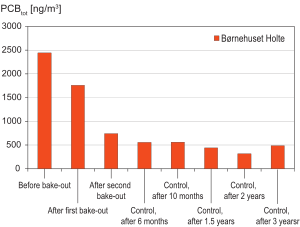
Figure A.1. Indoor air PCB concentrations measured before and after the bake-outs with increased ventilation rate and recirculated carbon-cleaned air. The measurements were performed during the summer and have been temperature-adjusted to 21 °C (Frimannsson á Brunni & Jensen, 2010; Hougaard, 2011).
Case Højmeskolen
At Højmeskolen in Odense, a bake-out was performed in a limited area on two walls around an expansion joint. The intention was to reduce PCB concentrations in the secondary contaminated concrete. Expansion joints with a content of 250,000-300,000 mg PCB/kg were removed and the edges were sanded down. Heated bars were then installed, and the air exchange rate was increased across and close to the opening. The bake-out period lasted four hours at temperatures of 68–73 °C and a ventilation rate of 1,000 m3/h.
The study was conducted in two classrooms (room 1 and room 2). Primary sources were removed from both rooms. In room 1, the primary sources were removed in controlled conditions using shielding, to minimise PCB deposits on the remaining surface areas in the room. In room 2, the primary sources were removed without special measures being taken (i.e., unshielded). Moreover, all painted surfaces were sanded down in room 1 and the flooring was removed, while none of this was done in room 2. The PCB concentration in the wall paint was 1,800 mg/kg while contents in the adjacent concrete measured 35 mg/kg at 25 millimetres from the joint (Grarup, 2011).
Following the bake-out, new caulk was applied everywhere, and indoor-air PCB concentrations were remeasured (Grarup, 2011). The results are indicated in Figure A.2. Most measurements were performed at 16–17 °C and some at 19 °C (Grarup, 2011). To make measurements comparable,they were temperature-adjusted to 21 °C (Frimannsson á Brunni & Jensen, 2010; Hougaard, 2011). It appears that the bake-out reduced PCB concentrations in the indoor air.
Moreover, the measurement seems to indicate that screening, paint removal, etc., in room 1 had an added positive effect as the drop in concentrations was relatively bigger than in room 2.
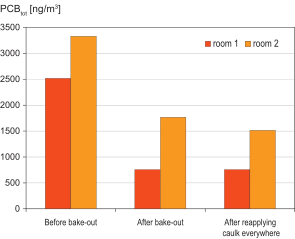
Figure A.2. PCB concentrations in the indoor air before and after 4 hours of local bake-out of secondary contaminated sources coupled with an increased ventilation rate locally, conducted in two classrooms at a school in Odense (Grarup, 2011). The classrooms (room 1 and room 2) were treated differently prior to the bake-out (cf. the above text).
Case the Flats in Birkhøjterrasserne
Two bake-out studies were conducted in flats in Birkhøjterrasserne on the Farum Midtpunkt housing estate.
Box Room
The first study was conducted in a box room measuring 11 m3 in a flat contaminated by PCBs. The box room had a painted surface area of 25 m2 with a PCB concentration of 100–300 mg/kg in the paint. Primary sources (caulk) and secondary sources (50 mm of concrete adjacent to the joint) were cut out and a new door and door frame were fitted.
Two bake-out periods were implemented. During both bake-outs, there were periods when the air was cleaned by means of a carbon filter and an air-exchange rate of 10 times per hour. There were also periods without air cleaning and an air exchange rate of 0.02–0.1 times per hour (depending on the temperature). During the first bake-out period, the room was heated to a temperature of 40–43 °C for ten days. After 5 weeks of normal temperatures, a second bake-out was implemented where the temperature was increased stepwise by 5 degrees from 27 to 43 °C. During both bake-out periods, indoor-air PCB concentrations were measured periodically with and without air carbon-filtration. The results are detailed in Figure A.3 (top).
Flat
In the second study, the method was tested in a completed flat with a volume of 280 m3. Prior to the bake-out, caulk and the adjoining concrete were cut out and the floor and kitchen units were removed. The wall paint (with a PCB concentration of 100–300 mg/kg) remained on the walls. The painted area totalled 390 m2.
During the first bake-out, the temperature was kept at 52–54 °C for five days. After measuring the indoor air at normal temperatures, the 50 °C bake-out was repeated for five days. During the whole bake-out period, the air was cleaned using carbon filters with an air exchange rate of 4.2 per hour (Lundsgaard, 2011). The results are indicated in Figure A.3 (bottom) and (to make the measurements comparable) results were temperature-adjusted to 21 °C (Frimannsson á Brunni & Jensen, 2010; Hougaard, 2011).
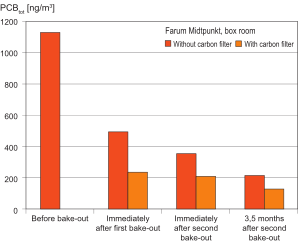
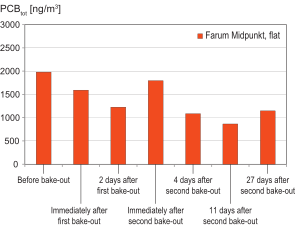
Figure A.3. PCB concentrations in the indoor air before and after bake-out on the Farum Midtpunkt housing estate. Top: Bake-out in the box room. Bottom: Bake-out in the flat (Lundsgaard, 2011).
The significance of increased ventilation during bake-out was proven on the Farum Midtpunkt housing estate where PCB concentrations were measured with and without increased rates of air exchange. The air needs to be filtered using carbon filters during bake-out to remove off-gassing PCBs.
Case Gastrup Skole
A screening of municipal school buildings in Roskilde Municipality indicated that the indoor air in the classrooms of the first-year primary classes at Gadstrup Skole had a PCB content that fell just below the action value stipulated by the Danish Health Authority of 3,000 ng/m3. The source of the PCBs were leaking capacitors in some of the older lighting fixtures integrated into a suspended ceiling system. PCB concentrations in the indoor air appeared to have caused an extensive tertiary contamination of all surface areas in the building.
A combined remediation solution was selected where the most polluted materials were removed from the building followed by a bake-out (thermal stripping) and encapsulation of selected surface areas. Following the abatement intervention, restoration, and the installation of a ventilation system, indoor air PCB concentrations were measured at approx. 140 ng/m3 (Golder Associates A/S, 2015).
Basis
The first-year primary section was built in 1972. It measures 1,600 m2 and comprises several classrooms and a communal area with a total of 178 roof lights. Surrounding the light wells for the roof lights, lighting fixtures had been integrated into a suspended ceiling system. The lighting fixtures comprised some 750 capacitors placed on the upper side of the lighting fixtures above the suspended ceiling system. The primary PCB source in the building was leakage from these capacitors. Indoor-air PCB concentrations measured 1,500-3,800 ng/m3 but totalled 8,000–18,000 ng/m3 in the space above the suspended ceiling. The municipality began investigations comprising extensive mapping of PCBs in materials and air as well as laboratory tests involving bake-out and encapsulation of PCB-contaminated materials. Based on these investigations, the total PCB content in the building was estimated at 12 kg with approx. 6.5 kg in capacitors and 5.5 kg in materials. Removing capacitors and the suspended ceiling system effectively removed approx. 9 kg of PCBs while the residual approx. 3 kg consisted of tertiary contaminated materials.
Process
Based on these investigations, a decision was made to remove capacitors and the suspended ceiling system and then to conduct a bake-out with subsequent encapsulation of selected materials. The bake-out and the simultaneous cleaning of the indoor air was conducted at 55–70 °C, a rate of air exchange of 10 times hourly (50,000 m3/hour), and a bake-out period of 21 days. The bake-out of the building was conducted during summer (warm outside temperatures) and the school’s district heating system could supply most of the heat at the specified temperature.However, it was also necessary to establish an external oil-fired burner to cover the remaining heating requirements. Based on measurements of the filtered air, an estimated 300–400 g of PCB was removed by the bake-out. This corresponds to the quantity of PCB which, under normal circumstances, would off-gas during about 6 years. Furniture was not part of the bake-out. After the bake-out, selected surface areas were sealed with a surface treatment based on a synthetic resin dispersion developed for the treatment of mildly PCB-contaminated building parts. Finally, a ventilation system was established and following this, PCB concentrations in the indoor air were measured at approx. 140 ng/m3.
Abatement measures including the removal of materials, bake-out, encapsulation, restoration of the building, and installation of ventilation system were implemented over a 15-week period. Approx. 30 % of the project costs were spent on removing PCB-contaminated materials while 42 % were spent on abatement comprising bake-out and encapsulation of selected surface areas (Golder Associates A/S, 2015).