7. Waste Management
Environmentally hazardous substances in CDW must be identified, separated out, and disposed of appropriately. This applies regardless of whether the waste derives from remediation, renovation, or demolition.
This section describes the rules for classifying, handling, storing, and disposing of PCB-contaminated CDW.
The website of the Danish EPA (www.mst.dk) describes who is responsible for separating CDW and what the local authorities may emphasise when deciding whether to classify CDW as hazardous waste.
7.1 Regulations
Waste-generating enterprises must always separate out hazardous waste, PCB-contaminated waste, and insulating glazing units from their CDW (see the Statutory Order on Waste, chapter 10, § 65, Erhvervsaffald og kildesorteret erhvervsaffald egnet til materialenyttiggørelse (Industrial Waste and Source-Separated Industrial Waste for Recovery) (Ministry of the Environment, 2012)). Hazardous waste must always be sorted and handled separately (see the Statutory Order on Waste, chapter 11, Særlige regler om farligt affald fra virksomheder (Special Rules for Hazardous Waste from Enterprises) (Ministry of the Environment, 2012)).
7.1.1 Statutory Order on Waste
Chapter 13 in the Statutory Order on Waste (Ministry of the Environment, 2012) stipulates special rules for private and professional building owners on identifying PCB in building and construction projects and waste notification. Prior to renovation or demolition, building owners must check whether there is a risk of the building (or parts of it) containing PCB.
The Statutory Order on Waste uses the term ’screening’, and this screening must determine whether PCB-contaminated materials may have been used during construction or renovation of a building or structure. Screening requirements apply to renovation or demolition of buildings, structures, or parts of these, built or renovated during the period 1950–1977. However, there is a lower threshold limit. The screening requirement applies if the renovation or demolition comprise more than 10 m2 of the building or generate more than 1 ton of waste. The replacement of insulated glazing units which might be produced during the period 1950–1977 is also subject to this rule (see Figure 31).
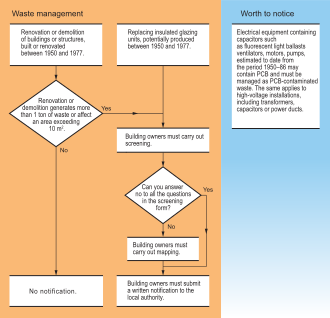
Figure 31. Schematic diagram of the provisions of the Statutory Order on Waste detailing when the local authority needs to be notified of renovation or demolition of a building or structure constructed or renovated during the period 1950–1977, and whether building owners have a duty to screen and map PCBs in their buildings or structures. The replacement of insulating glazing units potentially produced between 1950 and 1977 is also subject to the screening requirement.
The building surveys necessary prior to a renovation or demolition are described in SBi Guidelines 241, Survey and Assessment of Building-Related PCBs, 3 Surveys prior to renovation or demolition (Andersen, 2015). The building surveys are based on chapter 13 of the Statutory Order on Waste. The section also describes how to notify PCB-contaminated CDW.
7.1.2 Persistent Organic Pollutants (POPs) Regulation
PCB is among the twelve environmental poisons known as ‘The Dirty Dozen’ in the Stockholm Convention. The obligations resulting from the Convention are gathered in the POP Regulation (the Council of the European Union, 2004). In general terms the Regulation sets out how PCB-contaminated waste must be managed within the EU.The basic provisions in the POPs Regulation stipulate that PCB-contaminated waste must be separated out from other waste and then incinerated. If PCB concentrations in the waste are below 50 mg/kg, the waste can be sent to landfill or recovery in accordance with applicable rules.
PCB-contaminated CDW with PCB levels low enough to be considered unpolluted exist. Furthermore, CDW containing small quantities of PCB, but which can still be reused under certain circumstances also exist. This type of waste is regulated by the POPs Regulation (POP-forordningen) (the Council of the European Union, 2004), the Statutory Order on Recycling of Residual Products and Soil in Building and Construction Work (Restproduktbekendtgørelsen) (Ministry of the Environment, 2016b), and the Environmental Protection Act (Ministry of the Environment, 2016a). Management of PCB-contaminated waste unfit for recovery is regulated by the POPs Regulation and the Statutory Order on the Landfill of Waste (Deponeringsbekendtgørelsen) (Ministry of the Environment, 2013).
Citizens and enterprises can obtain information about how to handle PCB-contaminated waste by contacting the local authority technical administration. The local authority will provide advice on how to handle PCB-contaminated waste unfit for recovery (Danish EPA, 2011).
7.2 PCB-Contaminated Building Materials
PCB-contaminated building materials are identified through systematic building screenings, the collection of samples, and their submission for chemical analysis. Caulk containing PCBs can be separated with relative ease from other waste while it is more complicated to separate secondary and tertiary polluted materials such as concrete.
Investigating building materials for PCBs is described in SBi Guidelines 241, Survey and Assessment of Building-Related PCBs, 5 Mapping the building materials (Andersen, 2015). Building materials to which PCBs may have been added are listed in Table 17 of SBi Guidelines 241, Survey and Assessment of Building-Related PCBs, 5.2 Construction products potentially containing PCBs (Andersen, 2015). Secondary and tertiary polluted materials are also described.
PCB-concentrations (in CDW for example) must be determined in accordance with the guidelines in DS/EN 15308 (Danish Standard, 2008). According to this standard, analyses are conducted to identify the seven indicator congeners (PCB-28, PCB-52, PCB-101, PCB-118, PCB-138, PCB-153, and PCB-180) where the sum is PCBsum7 (see SBi Guidelines 241, Survey and Assessment of Building-Related PCBs, 1.1 Commercial PCB products (Andersen, 2015) and SBi-Guidelines 241, Survey and Assessment of Building-Related PCBs, 6.2 Analytical testing package (Andersen, 2015)).
As a rule, the PCBsum7 is multiplied by a correction factor of 5 to determine the total PCB content (PCB-total) in the sample. The total PCB concentration is used to determine whether the waste is hazardous waste.
If the analysis identifies the original PCB product type, the correction factor for the specific product type can be applied (see SBi Guidelines 241, Survey and Assessment of Building-Related PCBs, 1.1 Commercial PCB products, (Andersen, 2015) and SBi Guidelines 241, Survey and Assessment of Building-Related PCBs, 6.2 Analytical testing package (Andersen, 2015)). This more precise determination of PCB content might, for example, be relevant if the analysis result is close to 50 mg/kg, which is the limit value for hazardous waste (Danish EPA, 2011). The City of Copenhagen has set PCB concentrations for both PCB-total and PCB sum7 below which materials can be considered unpolluted (City of Copenhagen, 2012).
7.3 Sorting Construction and Demolition Waste with PCBs
This section describes the duties of private persons and waste-generating enterprises to sort CDW. If a workman or contractor, according to agreement, disposes of PCB-contaminated CDW from households, it is no longer considered household waste, but industrial waste (www.pcb-guiden.dk). Industrial waste, including CDW, is waste generated by enterprises (Ministry of the Environment, 2012).
7.3.1 Waste-Generating Enterprises
According to § 65 (1) of the Statutory Order on Waste, enterprises generating waste must always separate hazardous waste, PCB-contaminated waste, and insulating glazing units from CDW. Furthermore, waste-generating enterprises must sort the part of their industrial waste deemed fit for recovery (see the Statutory Order on Waste (Ministry of the Environment, 2012)). In § 65 (2) of the order, CDW must be separated on site if the total quantity of waste exceeds 1 ton. In that case, waste must be separated into several fractions such as unglazed brick, concrete, iron and metal, and gypsum.
When waste-generating enterprises sort their CDW for recovery, they must ensure that everything except for mortar and reinforcing iron is separated out (see § 65 (4) in the Statutory Order on Waste (Ministry of the Environment, 2012)). This means that PCB-containing caulk and other materials contaminated by PCBs must be identified and separated out (Danish EPA, 2011, Ministry of the Environment, 2012).
There are rules for the recycling or reuse of insulating glazing units (see § 65 (3) in the Statutory Order on Waste (Ministry of the Environment, 2012)). Insulating glazing units with PCB-contaminated plastic sealant or residual PCB-contaminated mounting materials must be separated out and incinerated or sent to landfill (Danish EPA, 2011; Ministry of the Environment, 2012). The Danish EPA has published guidelines on the handling of insulating glazing units contaminated by PCBs (Danish EPA, 2014).
Pursuant to the Statutory Order on Waste, § 65 (5), on-site waste separation can be dispensed with if the total amount of CDW does not exceed 1 ton. If relevant, the local authority will direct the waste for sorting. The waste-generating enterprise may decide to send the part of the unsorted CDW fit for recovery on to fractional sorting at sorting plants. The sorting plant must be registered in a ’waste register’ as ’collection enterprise with pre-treatment plant’ (see § 65 (5) and (6) in the Statutory Order on Waste (Ministry of the Environment, 2012)). These exceptions notwithstanding, the waste-generating enterprise must ensure that CDW containing PCB is identified and separated (Danish EPA, 2011; Ministry of the Environment 2012). Insulating glazing units must also be separated (Danish EPA, 2011; Ministry of the Environment 2012).
7.3.2 Private Persons
Private persons have a duty to deliver CDW contaminated by PCBs to municipal recycling stations (see www.pcb-guiden.dk). According to § 35 in the Statutory Order on Waste, the local authority has a duty to set up a scheme for CDW, giving the households the possibility of sorting in accordance with the sorting requirements applicable to waste-generating enterprises (see Section 7.3.1, Waste-Generating Enterprises). This means that private persons must separate hazardous waste, waste containing PCBs, and insulating glazing units.
7.3.3 Responsibility for Waste Sorting
The waste-generating enterprise is responsible for ensuring that waste contaminated by PCBs is separated and handled appropriately in connection with demolition or building renovation. In this context, the waste-generating enterprise is regarded as the building owner or, if stipulated in the contract, the responsibility for managing the waste will be assumed by the contractor (Danish EPA, 2011).
The local authorities are responsible for overseeing that the rules are complied with (Danish EPA, 2011).
7.4 Classifying Waste
Pursuant to § 4 in the Statutory Order on Waste, the local authority decides whether a substance or object constitutes waste (Ministry of the Environment, 2012). Furthermore, the local authority decides whether the waste is classified as hazardous waste, packaging waste, waste fit for recovery, incineration, or landfill.
PCB waste with a content of 50 mg PCB/kg or more, is considered hazardous waste while waste with content below 50 mg PCB/kg is non-hazardous. Classification and management of PCB-contaminated waste is described in detail in SBi Guidelines 241, Survey and Assessment of Building-Related PCBs, 3.5.4 Classifying waste (Andersen 2015). Table 14 in SBi Guidelines 241 indicates how industrial CDW is defined based on PCB concentrations in the waste and how to manage PCB-contaminated waste. The table indicates specific guidelines for depositing PCB-contaminated waste at a landfill (see www.pcb-guiden.dk).
7.4.1 Hazardous Waste
Waste with a content of 50 mg PCB/kg or more is considered hazardous waste in the Executive Order on PCB, PCT and substitutes for these chemical compounds (Bekendtgørelse om PCB, PCT og erstatningsstoffer herfor) (Ministry of the Environment, 1998).
Pursuant to § 70 in the Statutory Order on Waste (Ministry of the Environment, 2012), enterprises generating hazardous waste (except for explosive waste), must notify their local authority. The notification must comprise information on waste type (EWC code (EAK-kode)), quantity, packaging, and the composition and properties of the waste. Pursuant to § 74 in the Statutory Order on Waste, enterprises generating hazardous waste must ensure that this is securely packaged relative to its composition, quantity, weight, volume, etc.
According to § 73 of the Statutory Order on Waste, enterprises generating or handling hazardous waste must ensure that hazardous waste is not diluted or mixed with other hazardous or non-hazardous waste. This applies if no permission has been given pursuant to the law, or rules issued pursuant to the law.
7.4.2 Waste Fit for Recovery
PCB concentrations in waste determine whether it is possible to utilise CDW containing PCBs (for backfill, for example). If PCB content in the CDW is sufficiently low to be designated ’unpolluted’, it can be utilised freely according to the rules on unpolluted CDW in the Statutory Order on Recycling of Residual Products and Soil in Building and Construction Work, § 12 (Ministry of the Environment, 2016b).
The Statutory Order on Recycling of Residual Products and Soil in Building and Construction Work came into force on 1 January 2017 (Ministry of the Environment, 2016b). In it, the Danish EPA determined a limit value for the use of lightly polluted PCB-contaminated CDW to substitute primary raw materials in building and construction work. The limit value was set to max. 2.0 mg PCB-total/kg before demolition (measured at source and on the surface where the concentration is estimated to be highest). This constitutes so-called ’conditional use’, which means that the waste can be utilised to substitute primary raw materials without permission from the authorities, provided that certain conditions are complied with. Among other things, the PCB content of the waste must not exceed the limit value of 2.0 mg PCB-total/kg prior to demolition and after clean-up, if applicable. According to the Danish EPA, the Statutory Order (§ 13) stipulates that, in the future, the local authority cannot issue permissions (pursuant to § 19 of the Environmental Protection Act) or give environmental approval for the use of CDW with a PCB content exceeding the limit value of 2.0 mg PCB-total/kg for building and construction work (pursuant to § 33).
The authorities are working to determine a national limit value to define when PCB content in CDW is sufficiently low for the waste to be designated as unpolluted and hence fit for recycling or to be prepared for reuse. Until the national limit value has been determined, the Danish EPA refers to the City of Copenhagen PCB guidelines (www.pcb-guiden.dk). The City of Copenhagen has determined a recommended limit of 0.1 mg PCB-total per kg (0.1 ppm), corresponding to 0.02 mg PCBsum7 per kg (0.02 ppm) (City of Copenhagen, 2012).
The building owner who utilises the waste is responsible for ensuring that the waste is sorted and uncontaminated while the local authorities are responsible for ensuring that the rules are complied with. Likewise, the local authorities will determine whether the waste is unpolluted (Danish EPA, 2011).
7.4.3 Capacitors and electronic Waste Contaminated by PCBs
Capacitors (e.g., from fluorescent light ballasts) may contain PCBs. As a rule, manufacturers have a duty to recover electrical and electronic equipment (EEE) from enterprises if purchased after 1 April 2006. The local authority must set up a collection scheme for households for handing in EEE to the local authority and manufacturers regardless of when the equipment was acquired. In practice, it is usually achieved by handing in the entire lighting fixture to an approved enterprise, which will then remove and dispose of the capacitor.
Capacitors with PCBs must be handled carefully to avoid leakage and be handed in to enterprises approved to handle PCB-contaminated waste. The Danish EPA has published guidelines on handling capacitors in lighting fixtures containing PCBs (Danish EPA, 2015).
7.5 Handling and Storage
7.5.1 Packaging
The construction site must be planned to facilitate waste sorting. Waste-containing PCBs must be collected immediately and stored in closed containers to limit evaporation and avoid dust dispersal and leaching. This will also prevent PCB-contaminated waste being mixed with other waste. Closed containers could include lidded buckets, clip-top drums, or containers. The waste is disposed of in accordance with local authority guidelines for materials containing PCBs (Danish EPA, 2011).
Table 16. Packaging of various types of waste containing PCBs.
Waste type | Packaging |
|---|---|
Caulk removed from buildings | Clip-top drums or other tight-fitting lidded packaging |
Insulating glazing units/windows/doors/door frames | Separate containers |
Concrete and edge off-cuts | Containers |
Soil | Containers |
Other waste containing PCBs | Packaged in tight containers or drums |
Waste containing PCBs should, as far as possible, be stored outside buildings which are operating during renovation or occupied by people not wearing PPE (Dansk Asbestforening, 2010).
7.5.2 EWC-Code Labelling
Containers and drums for storing CDW containing PCB with concentrations exceeding 50 mg/kg (hazardous waste) are labelled with the EWC code 17 09 02. This type of waste comprises CDW with PCB (e.g., caulk containing PCBs, PCB-contaminated resin-based flooring, insulating glazing units with PCBs and capacitors with PCBs).
Waste with PCB concentrations below 50 mg/kg are labelled with the EWC code 17 09 04, comprising CDW except for waste labelled with the EWC codes 17 09 01, 17 09 02, and 17 09 03.
These EWC codes are explained in Table 17.
Table 17. Explaining the EWC codes (Ministry of the Environment, 2012).
EWC code | Explanation |
|---|---|
17 09 01 | CDW containing mercury |
17 09 02 | CDW with PCBs (e.g., caulk containing PCBs, PCB-contaminated resin-based flooring, PCB-contaminated insulating glazing units, and capacitors containing PCBs) |
17 09 03 | Other CDW (including mixed waste) containing hazardous substances |
17 09 04 | Mixed CDW except for waste categorised under 17 09 01, 17 09 02, and 17 09 03 |
Although the PCB waste contains less than 50 mg/kg, containers and drums should still be labelled as containing PCB to ensure correct handling and to avoid mixing with waste not containing PCBs. For practical reasons, containers and drums should also be labelled with waste type (e.g., residual caulk or insulating glazing units), eliminating any doubt as to which container or drum the waste should be deposited in.Non-hazardous waste (PCB concentrations below 50 mg/kg) should be incinerated at a plant approved to incinerate PCB-contaminated waste. However, it should be landfilled if it is difficult to handle (e.g., concrete) (see Table 14 in SBi Guidelines 241, Survey and Assessment of Building-Related PCBs, 3.5.4 Classifying waste (Andersen, 2015)). Assuming that all other provisions of the Statutory Order on the Landfilling of Waste are met, the Danish EPA estimates that disposing of PCB-contaminated waste to landfill should be conducted as follows:
- Waste with a PCB content less than 1 mg/kg can be deposited at a plant for chemically inactive waste.
- Waste with a PCB content between 1 and 50 mg/kg can be deposited at a landfill plant for mineral or mixed waste.
7.5.3 Carcinogenic Hazard Labelling
Waste containing PCBs must be labelled for cancer risk (see Annex 3 in the Statutory Order on Measures to Prevent Cancer Risks When Working with Substances and Materials (Bekendtgørelse om foranstaltninger til forebyggelse af kræftrisikoen ved arbejde med stoffer og materialer) (Ministry of Employment, 2015)). Containers carrying waste containing PCB not already labelled for cancer risk must therefore carry a label with the following text: ’Contains a substance subject to Danish working environment regulations concerning carcinogenic hazards’. Requirements for the design and position of the label are indicated in Annex 3 of the Statutory Order (Ministry of Employment, 2015).
7.5.4 Transport
Transport must be carried out by a registered haulier or collector. Find them on the Danish EPA website: www.affaldsregister.mst.dk.
7.5.5 Tools and Equipment
Tools and equipment such as knife blades and saws, vacuum-cleaner bags, and filters used during the work process should be considered to contain PCBs, be handled according to applicable rules and disposed of as PCB-contaminated waste (BrancheArbejdsmiljøRådet for Bygge og Anlæg, 2010).
Please remember other pollution sources such as lead or asbestos.
7.6 Disposal or Landfill
PCB-contaminated waste must, as a rule, either be landfilled or incinerated (Danish EPA, 2011). Industrial waste is defined according to the PCB concentrations contained in the waste (see Table 14 in SBi Guidelines 241, Survey and Assessment of Building-Related PCBs, 3.5.4 Classifying waste (Andersen, 2015)). The table includes specific guidelines for the landfilling of waste containing PCBs (see www.pcb-guiden.dk).The local authority will advise as to how PCB-contaminated waste should be handled (Danish EPA, 2011). Several incineration plants approved to incinerate PCBs exist, including EKOKEM (www.ekokem.com/dk) and SWS Special Waste Systems a/s (http://www.sws.dk/). The latter only treats flammable, hazardous PCB-contaminated CDW.